


Roots
“Growing up in Tehran, I knew no Jews and had not even heard of Jewish religion or people. Sure, I had friends and neighbors who were Zoroastrian, Armenian, and Bahai’s, but no Jews..” says Azita the new arrival at the hair salon I go to.
“That is so strange. Where did you live?” I ask.
“In the northside.”
“I don’t understand. When I lived in Tehran, there were so many prominent Jews living in that area,” I respond.
Azita gives me a quizzical look, and then it suddenly dawned on me. “I see. You were born after the 1979 revolution. After the mass immigration of the Jews from Iran.”
I cannot believe that over two Millenia of Jewish life in Iran has so easily come to an end. I do know there are still pockets of Jewish life remaining in certain cities, but now I realize that they have totally vanished in many towns, and even many parts of Tehran . What a loss! My ancestors lived in Iran for 2700 years, earlier than the written history of the country. They lived there, loved, got married, raised children, quarreled, quibbled, gossiped, faced prejudices, supported each other, created life, poetry, music, wines, and now their existence is erased not even with a whimper.
I remember the alley of my childhood. I am 4, running after the ice cream cart and the man who showed slides of foreign lands. Running along with me is my six year old sister teasing, fighting and flirting with the seven year old Darioush. We don’t even know the religion of our playmates. We just belong. Our home is brimming with hope. “Under the Pahlavi’s, we have come so far, and will do much more,” says my father while lifting us up at our door.
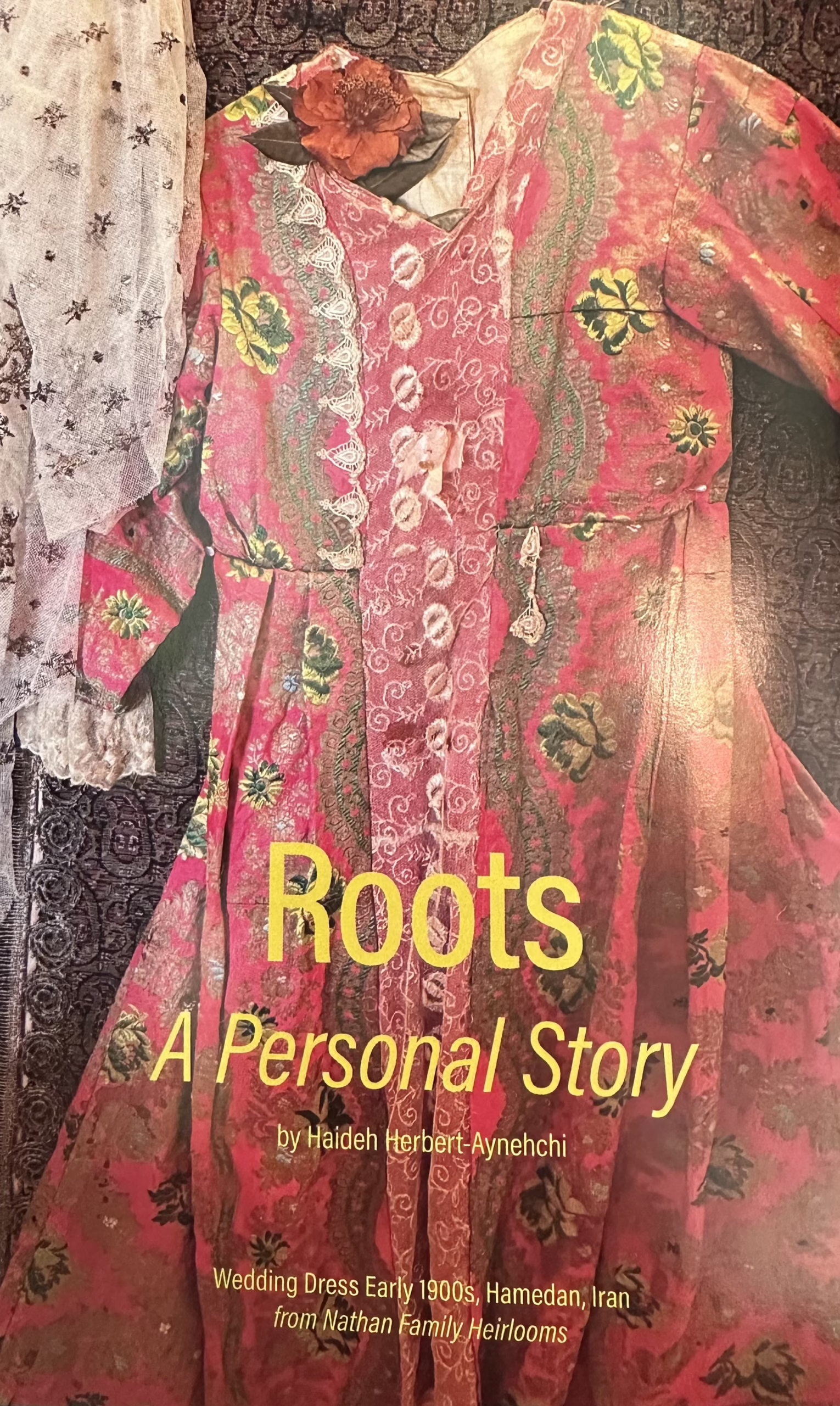
Entrenched with memories, I find myself standing at the door of my cousin, Vida, two blocks away from my home. She invites me in. On the wall of her living room, I see the familiar wedding dress of my beautiful Aunt Monir on display. I walk to the dress and stare. The golden threads, the festive bright pink and orange flowers, withstanding the damages of treacherous time, over a century, stare back at me. I see Aunt Monir vivacious and charming with her fair skin, beautiful green eyes and shiny black hair cascading over her shoulders under the traditional gold embroidered thin shawl. People told her she was beautiful and she took the compliment to heart. I smile to myself when I remember Aunt Monir’s indignant frown , when a naïve visitor dared to talk about beauty of Elizabeth Taylor in her presence.
I touch the dress and am suddenly drawn into a world of memories. I find myself in Aunt Monir’s big house of my childhood, I am picking up sweet mulberry fruit from the canvas laid out on the floor below the laden branches of the tree. I run back in, and my aunt gives me her signature sugar candy with almond slivers inside.
I love my aunt’s house. With four grown sons still living with them as was the tradition, the house is always full of energy and hope. All her sons are university students or graduates. Two pharmacists, one talented student of architecture at the School of Fine Arts, who also sings tenure on the radio each Thursday. He is the heart throb with the cute dimples, always laughing and talking about girls, and the youngest, the Medical School students. They are all first generation of university students in our extended family. Gone are the stories of my grandmother about the days that the Jews were confined to life in their own quarters, labelled as “najes __ dirty” and forbidden to hold any jobs that involved touching anything. Now, is the dawn of the brave new world, with hopes gliding in the air like fluffy bright clouds.
I remember the day that my medical school cousin introduces me to literature at 12. I am lying on a bed reading.
“What are you reading?” he asks.
“The center fold story in the magazine.”
“But that is only two pages. Do you want me to give you a story that runs through an entire book?”
I nod vehemently, and he gives me three volumes of Roman Rolland’s book, Jean Christophe. Now, I know that book is probably one of the longest novels ever written. It doesn’t matter. I devour them. When I return the books, he pulls a tiny book from his small bookshelf. It is a book of Khayam’s Rubaiyat, introducing me to questions about meaning of life and concepts of life and death. I become inseparable from books in poetry. He becomes my role model. I can be the first girl in our extended family attending the university. The doors are open, and I can.
Vida touches me on the shoulder and I return from a life that no longer exists. But how could that life not exist anymore. My aunt’s bright colorful dress and my memories keep that life real. They holds our roots. We brought our roots with us and planted them in the new land. The roots took, and the new land embraced and nourished them. The roots grew and yielded new strong and healthy branches. We are rooted here and belong. L’chaim America.